
Most AI conversations in our sector start in the wrong place – they start with a demo.
A chatbot answers a question on stage, the room nods, and nobody asks the only question that matters once the applause stops: where did the data go to produce that answer, and who else now has a copy of it?
For a membership organisation, that is not a technical footnote – it is the whole question. Your member records are the asset. The moment a prompt leaves your boundary and lands in a third-party model you do not control, you have made a decision about that asset, whether you meant to or not.
Cloudtoolz AI is built so that decision is yours to make, deliberately, every time.
We did not start with a chatbot. We started with control.
Cloudtoolz is the Digital Success Suite for iMIS organisations. It brings together AI, forms, pages, reporting, dashboards, a data lake, integration and automation, so that an association can serve members better.
At the centre of that suite sits the Cloudtoolz AI Control Plan, it’s not one more feature beside the others, it’s the governed foundation the others run on. It decides where models run, where data is processed, which tools the AI is allowed to touch, and which guardrails apply before a single token is generated.
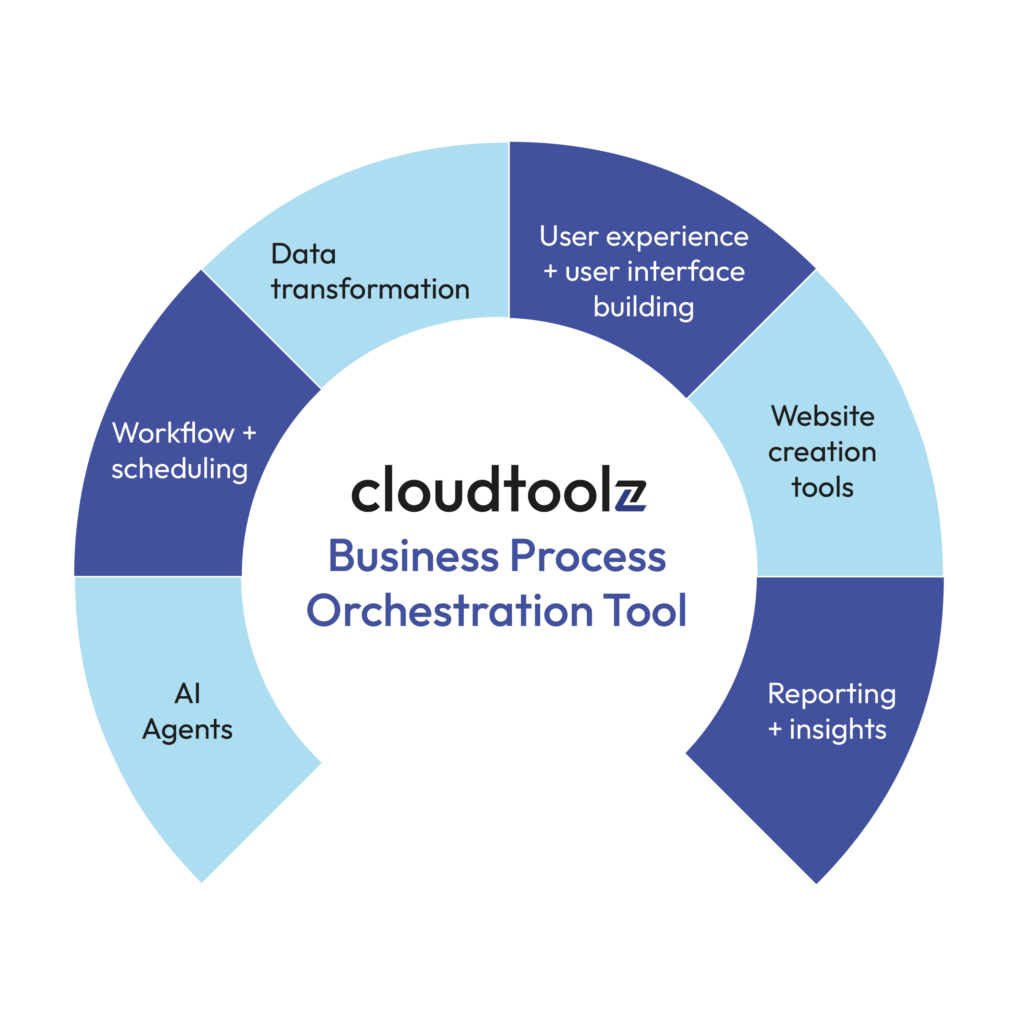
The architecture follows the same logic – control comes first, and intelligence sits on top of it. Action, discovery, visibility and data all draw from the same governed core rather than each making its own quiet decision about where your member data travels.
What the Control Plane actually governs
Four things, in plain terms:
1.Data sovereignty – You choose the deployment pattern: hosted in your region, privately deployed, bring your own model, or fully self-hosted for the workloads you will not let leave your environment. For German and Australian organisations carrying real data residency obligations, this is not a configuration screen, it’s the reason the conversation can happen at all. The AI adapts to your governance model, you do not bend your governance to fit the AI.
2. Governed tool access – The AI does not get a free hand inside iMIS. It acts only through approved Cloudtoolz workflows and business logic. It cannot invent an action you never sanctioned, because the actions available to it are the ones you defined.
3. Secure, natural-language access to your own data – Authorised users can ask questions of iMIS data directly, through schema-aware and permission-aware Text-2-SQL. The permission model is not bolted on afterwards. Someone who cannot see a record in iMIS cannot reach it by rephrasing the question to an AI.
4. Cost and provider control – You route each workload to the appropriate model and set provider-specific spend caps. PII filtering, guardrails and approval steps sit in the path by default, not as an upgrade.
On the deployment that proves the point
For sensitive workloads, Cloudtoolz AI runs self-hosted models on infrastructure the customer controls. In one deployment pattern we run an efficient open-weight model on a single NVIDIA L4, keeping member data inside the customer’s own environment for the entire lifecycle of a request.
I include that detail deliberately, and I include it here rather than at the top. A membership director does not need to know which GPU is in the rack. A CTO, CIO or DPO does, because it is the difference between a sovereignty claim they have to take on faith and one they can verify. The hardware is not the product. The product is the guarantee the hardware makes possible: that for the workloads you designate, nothing crosses a boundary you did not authorise.
Why this is the right shape for iMIS organisations specifically
Generic AI assistants treat your data as fuel. That model is acceptable when the data is disposable. Member data is not. It is regulated, it is the basis of trust between an association and the people who fund it, and it is the thing a competitor cannot replicate.
iMIS-aware, governed AI is a different proposition from a chatbot pointed at a knowledge base. It understands the schema, it respects the permission model, it acts through defined business logic, and it processes data where you decided it should be processed. That is not a more cautious version of the same thing. It is a different thing.
The position, stated plainly
Cloudtoolz turns iMIS from a system of record into a system of relevance, with a governed AI control plane that keeps member data under your rules.
If you are evaluating AI for your organisation and the first thing a vendor shows you is the conversation, ask them the data question before you are impressed by anything else. Where does it go? Who holds it? What is the AI permitted to do once it is inside? If the answer is a shrug or a diagram with a third-party cloud at the centre of it, you already have your answer.
With Cloudtoolz AI, that question has an architectural answer. That is the part worth building a product around.
Additional resources for you
If you liked this post, check out our other articles on similar topics.

The strategic use of iMIS add ons
Zentso’s Co-Founder and CRO shares his recommendations on how to evaluate the value of an add-on and how to choose the right one

Understanding the short and long-term effects of AI adoption on the workforce
Balancing Progress, Employment, and Expertise in an AI-Driven Future

AI Features in 4 top email marketing platforms
The best email marketing tools with AI features