
Most website redesign projects begin with the same assumption: we need a new CMS. Platform selection gets the attention, the demos, and the budget line. What gets underestimated, almost every time, is the harder problem sitting behind it: moving years of accumulated content into the new platform without degrading it.
Here I share key learnings from a recent project where we migrated more than 250 pages from a legacy website into iMIS RiSE. It covers the engineering challenges we hit, the approach we took, and the outcome, written from the CTO’s perspective.
The challenge
Content migration is rarely framed as an engineering risk, which is exactly why it becomes one. The types of potential failures are well understood once you have lived through a few of them:
1. Volume
Hundreds of pages cannot be moved by hand on any realistic timeline or budget! This manual work invites inconsistency, fatigue errors, and a long list of pages that never get finished.
2. Source quality
Legacy sites are uneven. In this case the HTML was well structured, with clean markup, real images, and accessible PDF documents. That is the good scenario. Poorly structured source is where automated migration breaks down, because you cannot reliably transform what you cannot reliably analyse.
3. Metadata debt
The legacy site had almost no meta descriptions, tags, or keywords. Treating metadata as optional during a migration is a quiet way to carry technical debt straight into the new platform. Meta descriptions still shape how pages appear in search results, which affects click-through, and structured titles and clear metadata matter more as large language models increasingly determine how content is discovered.

4. Discoverability
Beyond metadata, the content itself has to be machine-readable. Clean semantic structure, proper H1s and H2s, real paragraph text, and accessible documents are what make a page easy to read. This is where working on how a page renders becomes a first-class concern rather than an implementation detail.
5. Link integrity
Five hundred pages means five hundred existing URLs, inbound links, and search rankings that cannot simply be discarded. Without redirects, a migration silently destroys accumulated SEO equity.
The approach
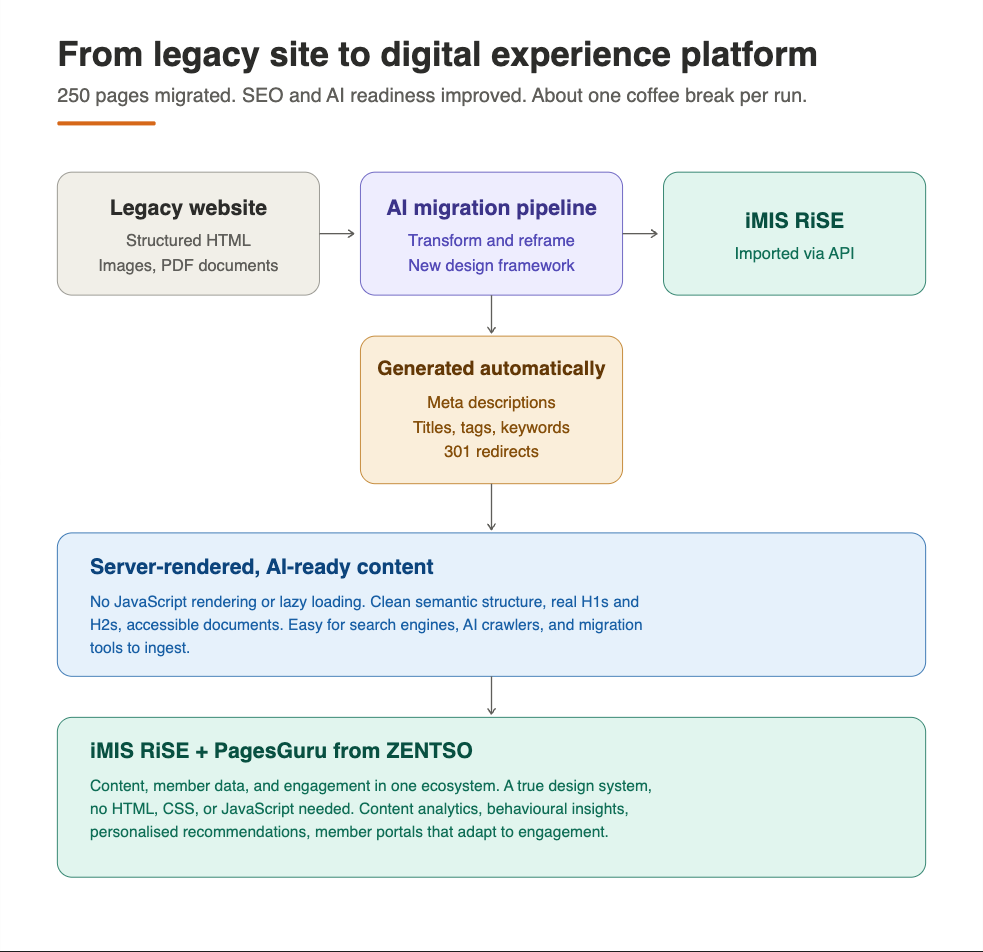
We treated the migration as a pipeline to be built once and run repeatedly, not as a one-off content project. The diagram below shows the shape of it.
Transform automatically, because the source allowed it
The source HTML was properly structured so we could transform it programmatically, apply a new design framework, and import the result directly into iMIS. This is the dependency worth stating plainly: automated migration is only as reliable as the structure of what you are migrating from. Well-formed input is what made the rest of the pipeline possible
Generate the missing metadata with AI
Rather than manually updating hundreds of pages to fill the metadata gap, we used AI to generate meta descriptions, titles, tags, and keywords as part of the migration itself. The generated metadata was then pushed into iMIS through the API alongside the content. This changed what would have been weeks of manual SEO work into a step in the pipeline. The same approach applies to pages you already have. You do not need a full migration, or a manual pass through every page, to improve SEO and AI readiness on an existing site.
Render server-side, deliberately
Content in iMIS RiSE is rendered server-side. That is an architectural choice with direct consequences for discoverability. There is no complex JavaScript rendering and no lazy-loaded content for search engines, AI crawlers, and migration tools to struggle with. LLM-based crawlers ingest what they can read directly, and well-structured server-rendered HTML gives them exactly that. For SEO, GEO, and AEO this is a measurable advantage over JavaScript-rendered CMSs.
Preserve link equity with 301s
Every migrated URL was mapped to its new destination with a 301 redirect, so existing inbound links and search rankings carried across rather than breaking. This is unglamorous work that is invisible when done correctly and very visible when skipped!
The outcome
The headline result is that the pipeline now does in a coffee break what would otherwise be a multi-week manual effort. Build it once, and each subsequent run is fast and repeatable.
| Dimension | Result |
| Pages Migrated | More than 250, transformed and imported automatically. |
| SEO foundations | Improved. Metadata generated where the source had none. |
| AI readiness | Improved. Clean, server-rendered, machine-parseable content. |
| Link integrity | 301 redirects in place across the migrated set. |
| Repeatability | Pipeline built once, each run takes the length of a coffee break. |
Why iMIS RiSE rather than a separate platform
A fair question I am often asked is why use the CMS built into iMIS rather than a separate platform. The answer is structural. For a membership organisation, the membership, events, committees, communities, subscriptions, and engagement data already live in iMIS. Keeping content in the same ecosystem makes it far easier to surface and personalise, because the content and the data it should respond to are not separated by an integration boundary.
Add PagesGuru from Zentso and non-technical users get a true design system without needing HTML, CSS, or JavaScript. From there the proposition shifts: content analytics, behavioural insights, personalised recommendations, and member portals that adapt to engagement. What starts as a website becomes a digital experience platform.
Takeaways for technical leaders
• Budget for content migration as an engineering workstream, not an afterthought to platform selection. It carries the higher hidden risk.
• Source structure determines what you can automate. Audit it before promising a timeline.
• Metadata and rendering strategy are now SEO and AI-discoverability decisions, not cosmetic ones.
• Build the migration as a repeatable pipeline. The second run, and every run after, is where the investment pays back.
• For membership organisations specifically, keeping content and member data in one ecosystem is worth more than the feature list of any standalone CMS.
If you are planning a redesign, it may be worth looking beyond WordPress, Wix, or Squarespace. For membership organisations, iMIS RiSE with PagesGuru is a powerful alternative that keeps content, data, and member engagement working together.
Additional resources for you
If you liked this post, check out our other articles on similar topics.

The strategic use of iMIS add ons
Zentso’s Co-Founder and CRO shares his recommendations on how to evaluate the value of an add-on and how to choose the right one

Five Mistakes Associations and Unions Make When Looking for a New CRM
Zentso’s Co-Founder and CRO shares a practical guide for membership organisations thinking about change
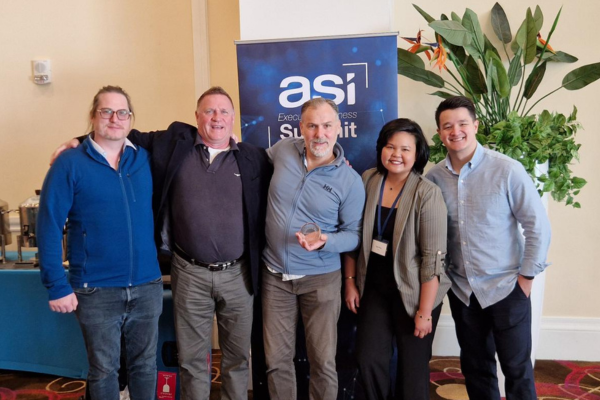
Team Zentso wins Chairman’s Circle Award at the ASI Executive Business Summit
Team Zentso attended the Executive Business Summit on the 24th – 26th of February 2026 and won the Chairman’s Circle award, which recognizes overall outstanding performance!