
As artificial intelligence keeps advancing, associations and membership organisations are looking for new ways to improve efficiency, automate routine tasks, and enhance the member experience. That’s where Salesforce’s new AI technology, Agentorce, steps in.
In our recent webinar, our Salesforce Consultant, Gyanesh Tailor, shared what Agentforce is and how it can be used.
You can watch the webinar recording here.
What is Agentforce?
Agentforce is part of Salesforce’s new “agentic layer” – a powerful suite of AI tools that introduces virtual agents capable of carrying out tasks automatically.
These agents can:
• Understand user intent and context
• Update records, send emails, and trigger workflows
• Work across apps and third-party systems
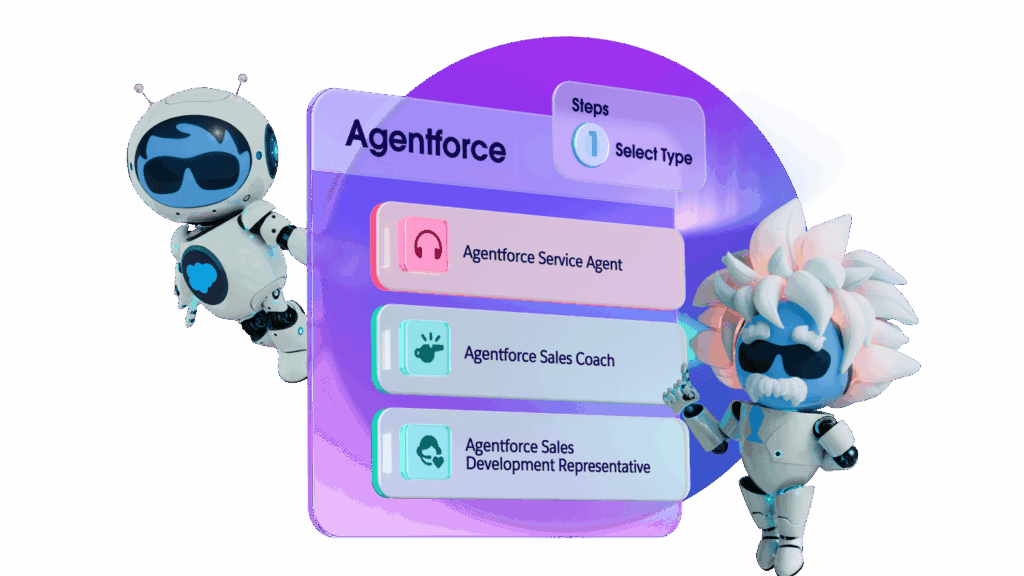
You can build multiple agents that can carry out tasks specific to each department in your business, this includes a service agent that interacts directly with your members or prospective members on your website or in your members’ portal.
Agentforce sits somewhere in the middle between the capabilities of bots and humans. Bots complete tasks based on set rules; they follow criteria to implement an outcome. Whilst AI agents can’t think like humans, they can reason and decide on the best course of action.
Deterministic and Non-deterministic
When it comes to AI, it gives two types of answers.
Deterministic – always produces the same output for the same input every time, mathematical processing. Eg. ‘what was our total revenue this year?’
Non-deterministic – produces different outputs for the same input.
Eg. ‘draft an email that includes…’
Salesforce provides all the tools necessary to combine both deterministic and non-deterministic responses, it intelligently responds to your queries with accurate data.
Can you trust Agentforce?
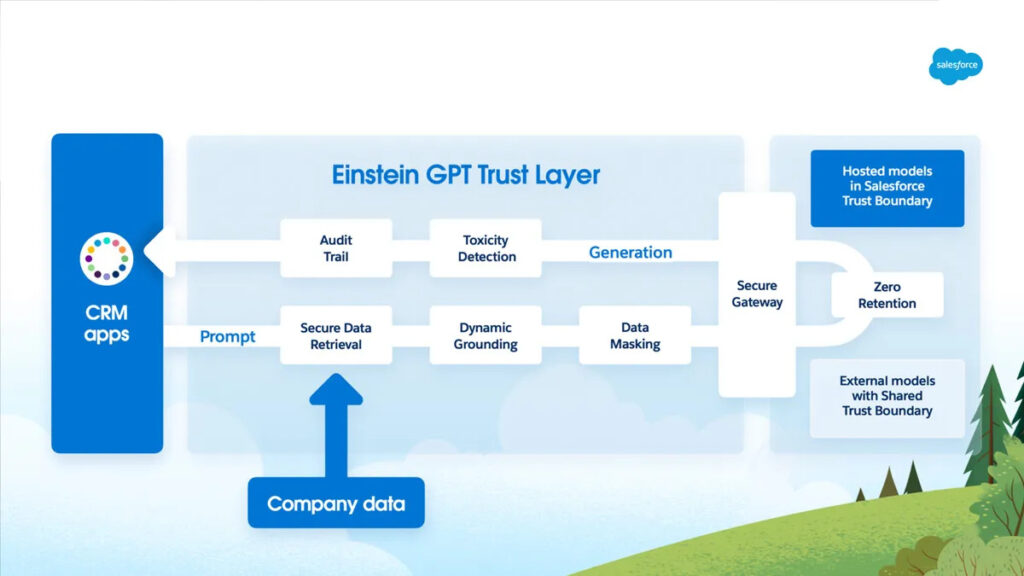
Understandably, trust and data privacy are top concerns. Salesforce’s Einstein Trust Layer is built into Agentforce by default.
No data is stored or used by Agentforce, and only data you’ve permitted for Agentforce to access will be used in your answers. There is also prompt defence and toxicity detection, which prevents the chance of harmful outputs.
How to get started with Agentforce
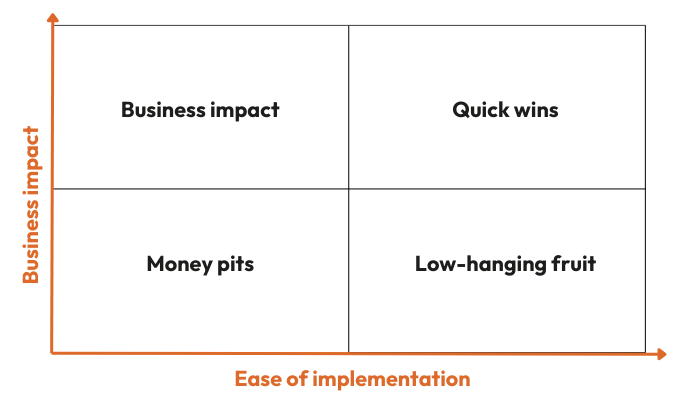
You don’t need a massive project to start using Agentforce. The best place to begin is with quick wins – small, high-impact use cases that are simple to implement.
Speak to different departments for suggestions on areas where Agentforce can help. Keep your end-user (the people who will using the tool) in mind to make sure the implementation is addressing real challenges.
It can be a good idea to complete a pilot project. The best approach to this is to choose a high value quick win project, which is easy to implement and delivers high business impact, without disrupting your business operations. Once your project is implemented, it can be used as a proof of concept to increase buy in at all levels of the business.
How much does Agentforce cost?
For Sales/Service cloud customers, you can get started with Agentforce for free. You’ll need to activate Salesforce Foundations, which can be done within the Salesforce platform itself by the Salesforce account holder.
Agent Force offers two flexible pricing models:
• Flex credits (20 credits per action): £400 for 100,000 credits.
• Conversation-based: £1.60 per full conversation.
To calculate costs, you will need to know your use cases first and what the usage volumes could look like. There will be other costs involved, such as the effort used to plan the implementation and any support you may receive for this, e.g. from external consultants.
Every organisation receives 100,000 credits for free when activating the Einstein for Developers Foundations pack – perfect for testing a pilot use case.
Do you have a question about how to get started with Agentforce?
We’re here to help, get in touch to speak to a Salesforce Consultant.
Additional resources for you
If you liked this post, check out our other articles on similar topics.

Types of Salesforce reports and when to use them
A summary of the different types of Salesforce reports
How membership organisations can use automation and AI
4 ways you can implement AI and automation

5 levels of agentic maturity
A summary of the key types of AI agents